🔥 A Sentinel-2 Benchmark for Deep-Learning Active-Fire Segmentation
Shreyan Mitra, Mohammadreza Narimani* (corresponding author), and Parastoo Farajpoor
Data in Brief · Volume 69 · Article 113357 · 2026 · Open access CC BY 4.0
Department of Biological and Agricultural Engineering · University of California, Davis
Why This Dataset
An active-fire mask locates ongoing combustion in a satellite scene. It is not a burn-scar map. Sentinel-2 shortwave infrared at 20 m can reveal those cores, but comparing segmentation models requires a shared rendering, a documented label rule, and a split that does not leak the same wildfire into training and test.
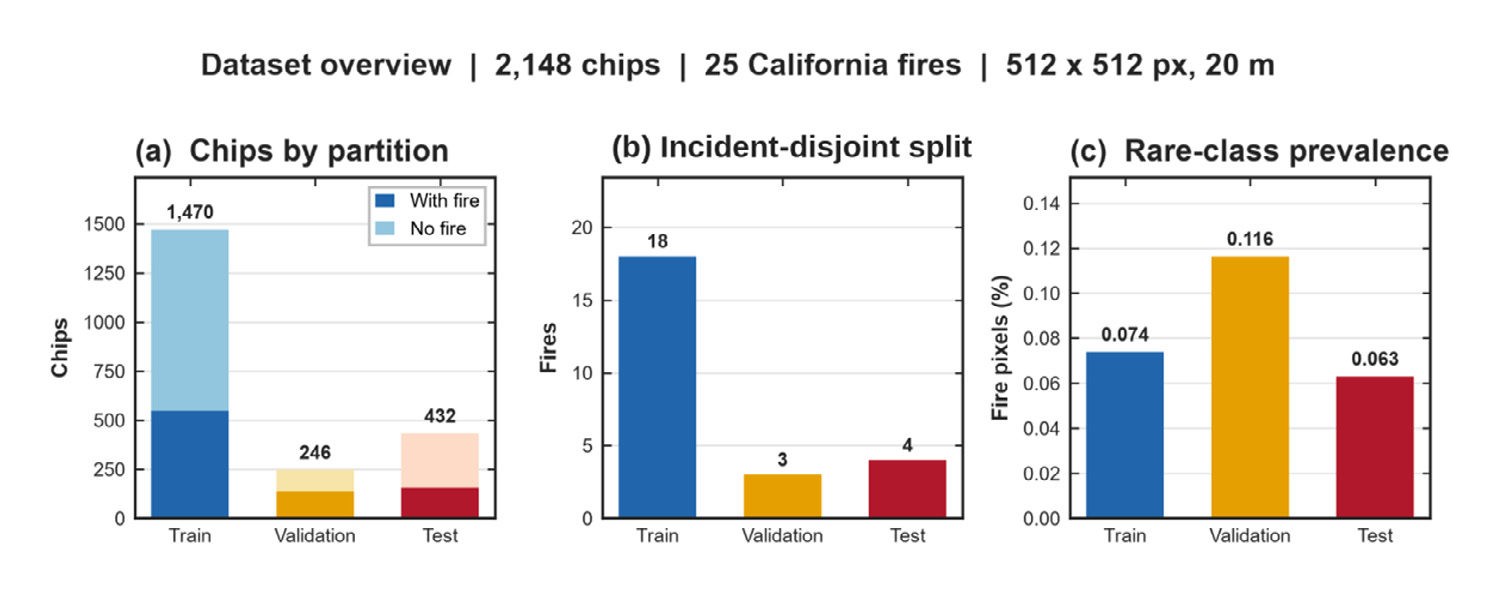
This open Data in Brief article by Mohammadreza Narimani (corresponding author), Shreyan Mitra, and Parastoo Farajpoor releases a fixed archive of 2,148 image–mask pairs from 25 California wildfires (23 July 2020–21 August 2026). Images are 512 × 512 three-channel composites of Sentinel-2 Level-2A bands B12, B11, and B8A with a single linear rendering. Masks code background (0), SWIR-rule active fire (1), and invalid observations (255).
Incident-Disjoint Splits
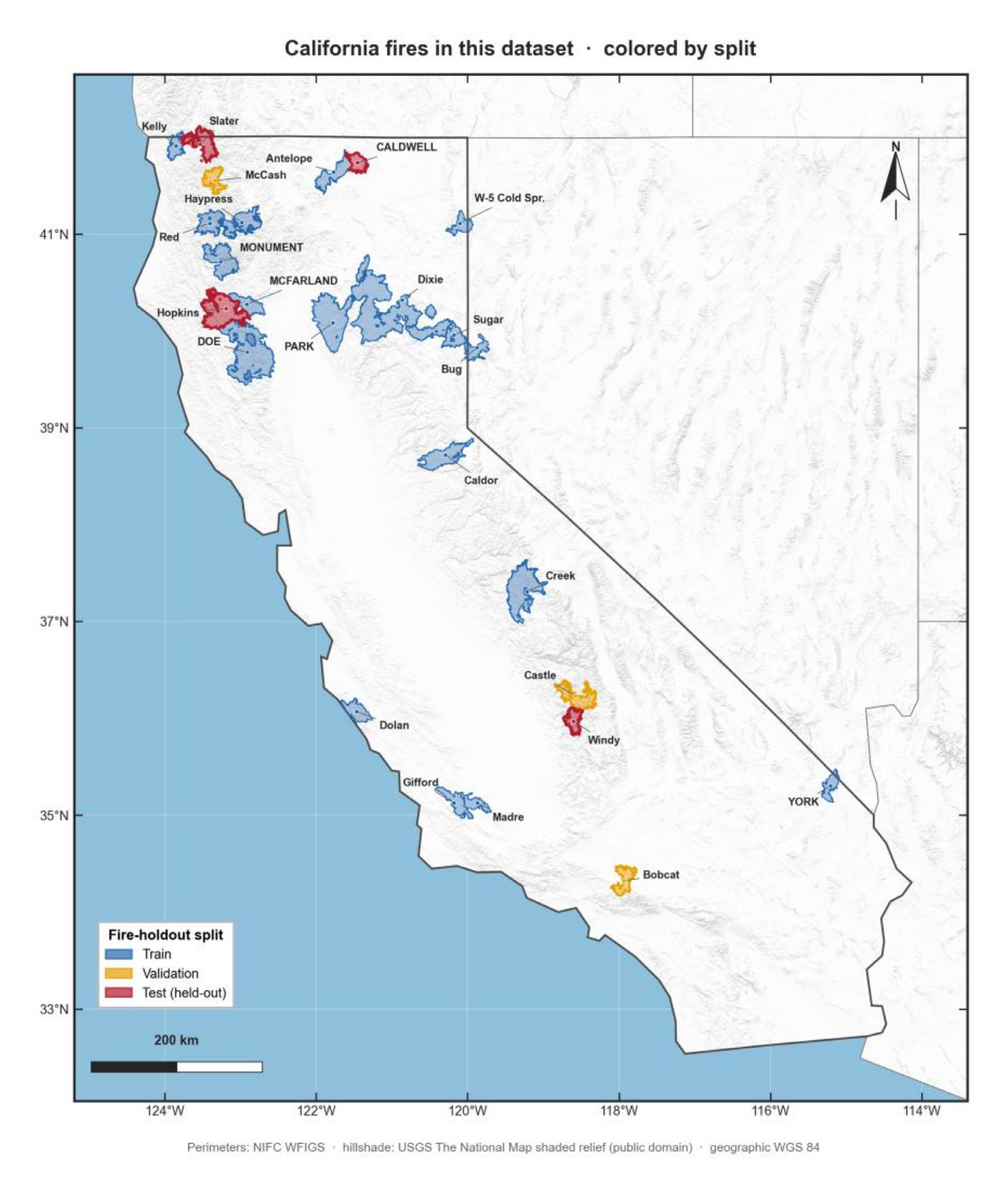
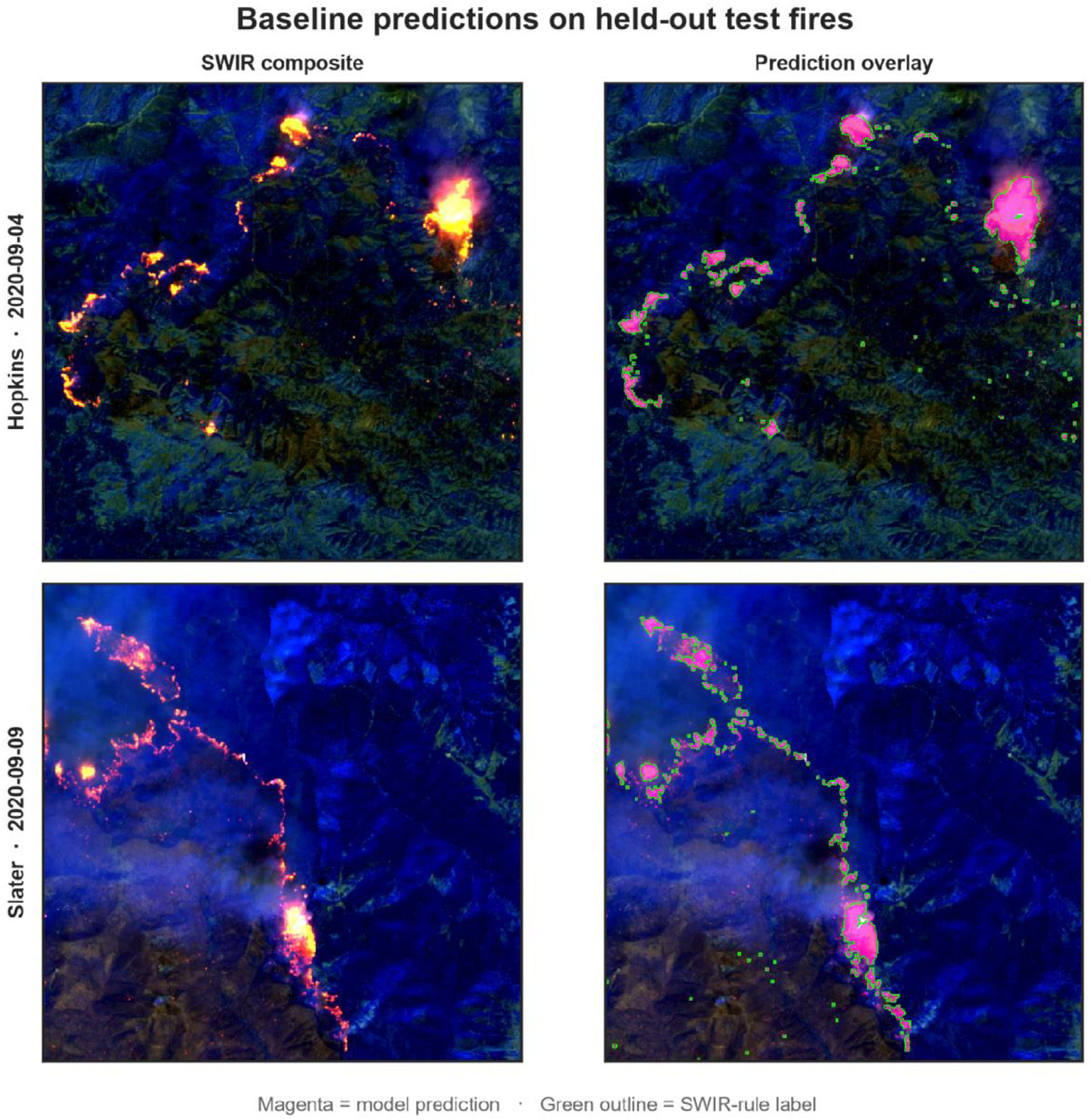
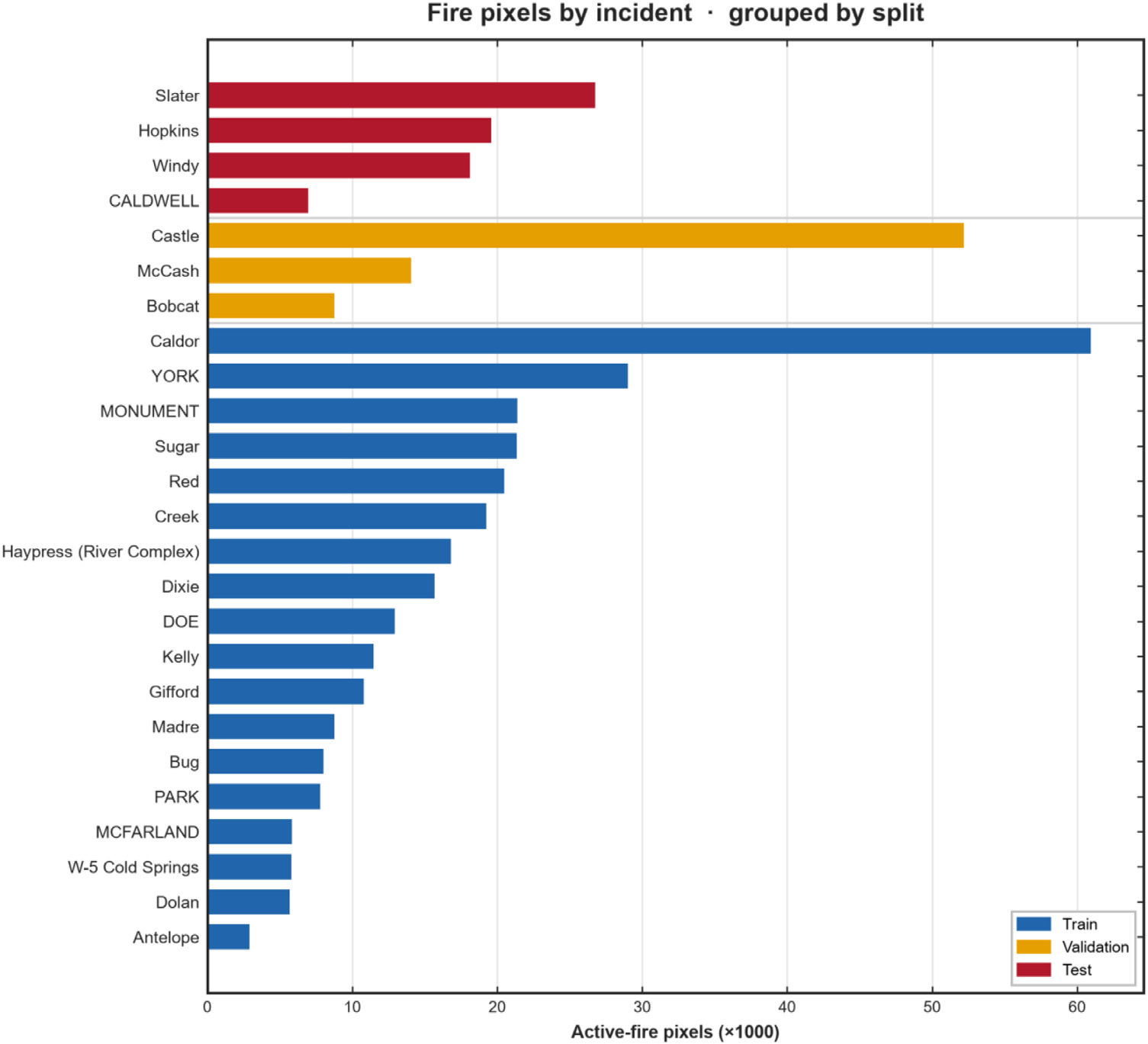
Partitions are assigned by wildfire name: 18 / 3 / 4 fires for train / validation / test (1,470 / 246 / 432 chips). Castle, McCash, and Bobcat are reserved for validation; Slater, Hopkins, CALDWELL, and Windy are reserved for testing. Every chip from a fire stays in one set, so grouped evaluation is possible on events the model has never seen.
SWIR Labeling and Example Chips
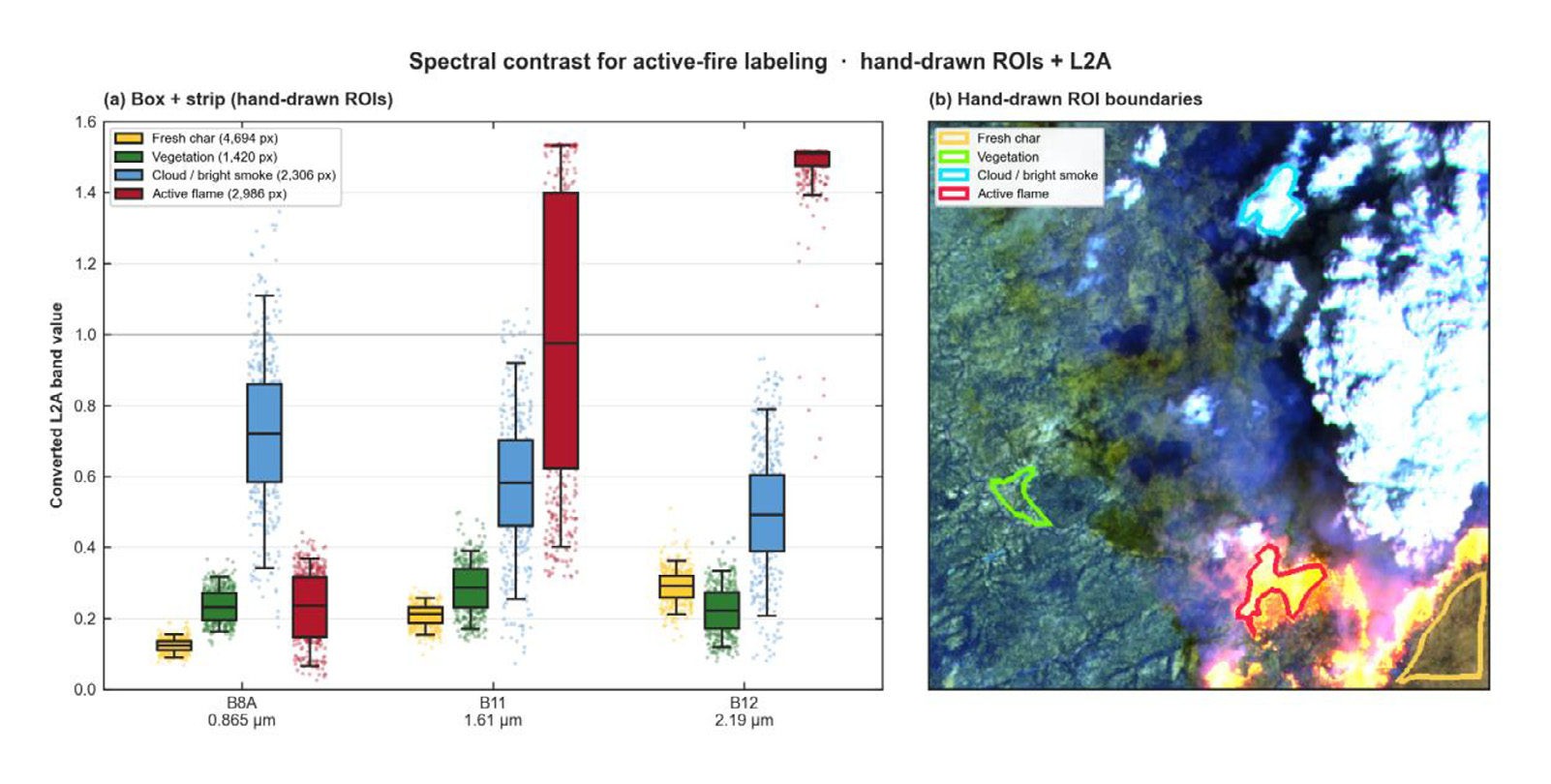
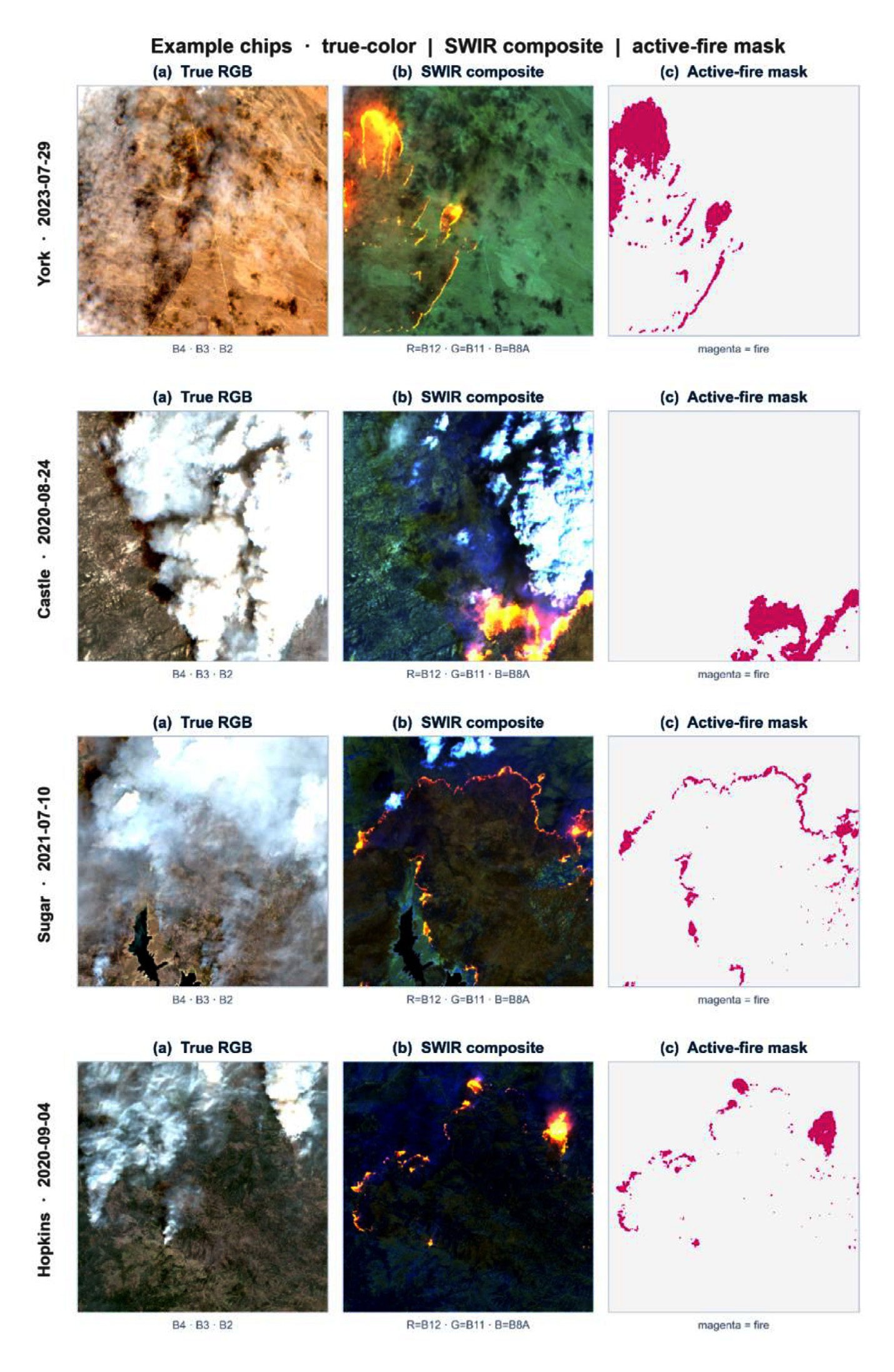
Labels come from shortwave-infrared brightness and near-infrared contrast, then two steps of neighborhood growth. Hand-drawn regions of interest show why B11 and B12 separate active flame from vegetation, char, and bright smoke. True-color RGB often hides the same cores under smoke.
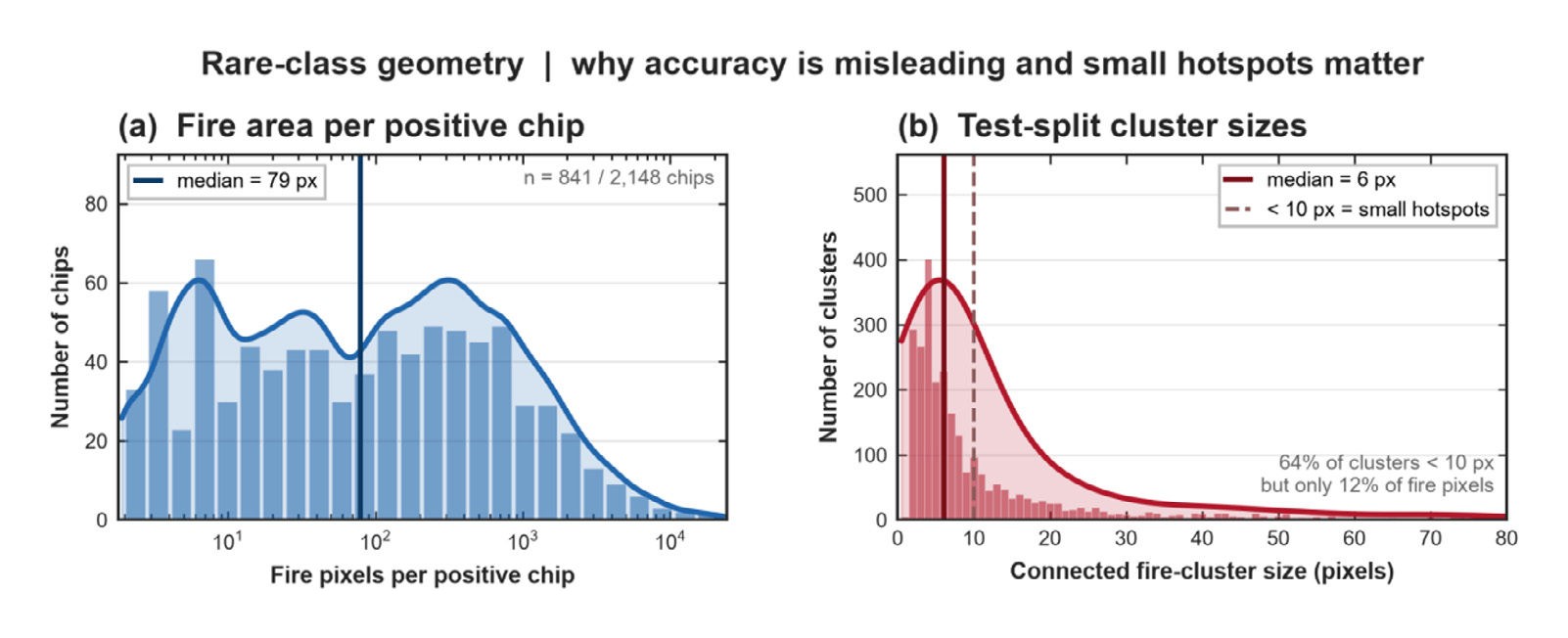
Fire labels occupy only 431,427 grid cells. Median fire area on a positive chip is 79 pixels; most connected clusters are small hotspots. Accuracy is therefore a poor headline metric—precision, recall, and overlap on rare positives matter more.
Analyst Review and Reference Model
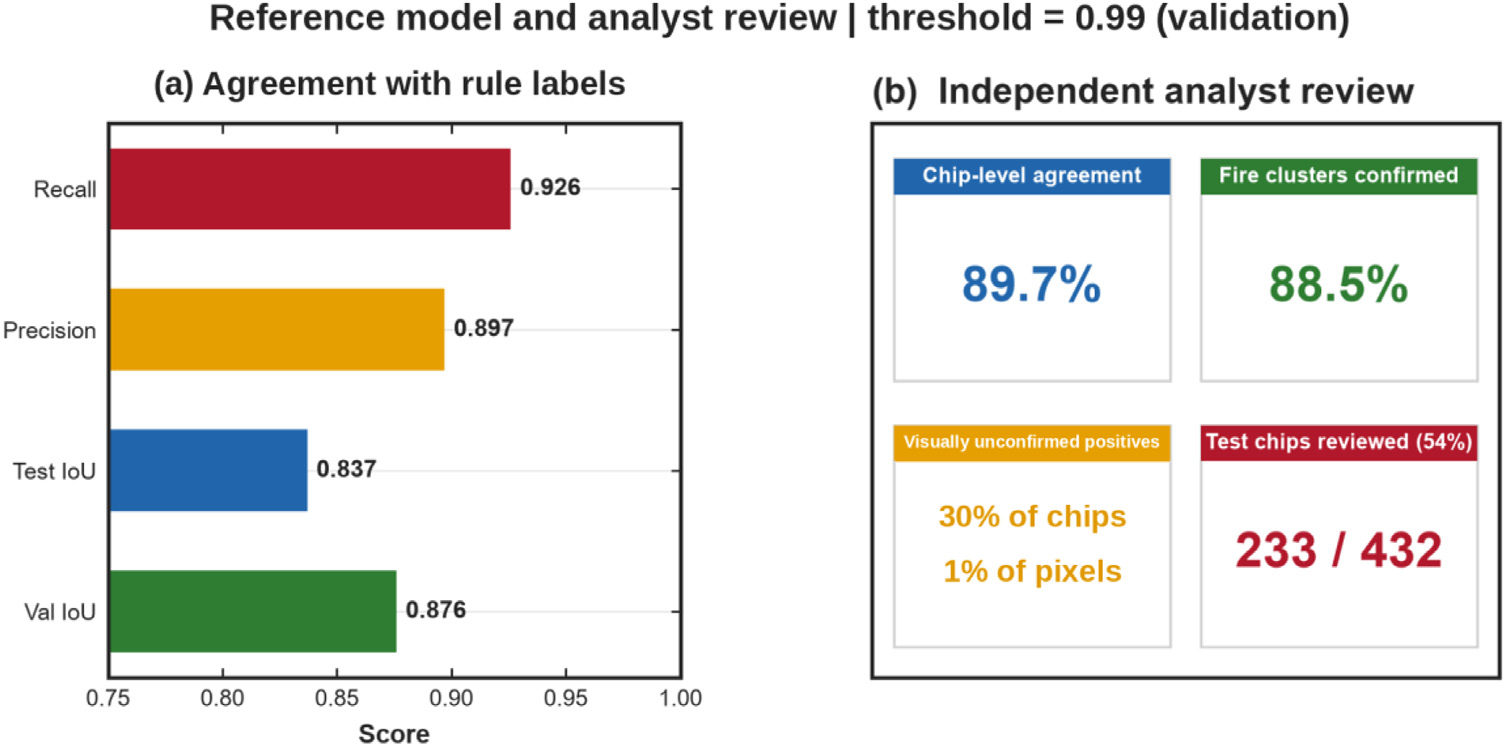
An analyst reviewed 233 of 432 test chips without seeing the rule masks. Chip-level agreement was 89.7% and rule-component confirmation was 88.5%. Those annotations stay separate from the training labels so users can score agreement independently.
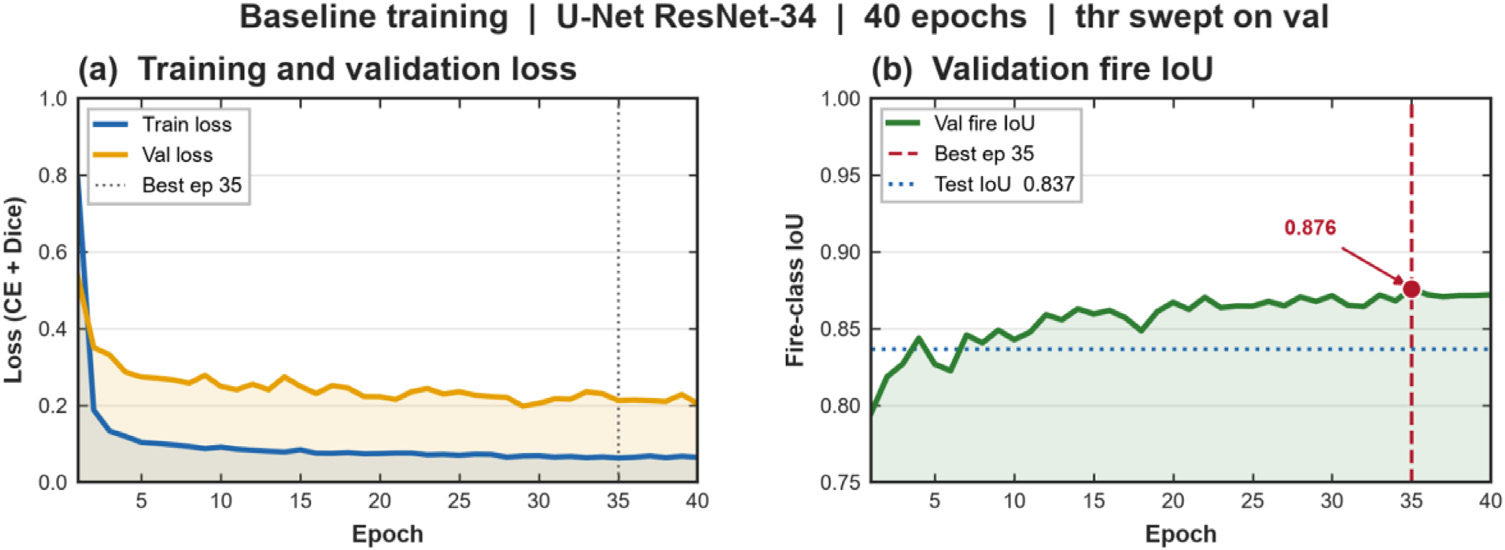
The companion repository includes dataset construction code and a ResNet-34 U-Net reference run with validation-based threshold selection. Dataset version 1.0.0 is pinned on Zenodo; software is MIT-licensed on GitHub. Use those versions if you want comparisons tied to this paper.
Fixed inputs
PNG images and integer masks with chip metadata, so methods can share the same files without reprocessing Sentinel-2 scenes.
Grouped evaluation
Wildfire-level partitions prevent the same incident from appearing in both training and test.
Rare-class design
Documented imbalance, invalid-pixel coding, and analyst review for honest segmentation metrics.
Paper and Citation
Mitra, S., Narimani, M., & Farajpoor, P. (2026). A Sentinel-2 benchmark dataset for deep-learning active-fire segmentation across 25 California wildfires, July 2020–August 2026. Data in Brief, 69, 113357.
DOI: 10.1016/j.dib.2026.113357 · Data: 10.5281/zenodo.22713948 · Open access under CC BY 4.0
Please cite the publisher version when you use this work. The summary on this page is a research card, not a substitute for the article.
Contact
Mohammadreza Narimani
PhD Candidate, University of California, Davis