🌲 Enhancing Wildfire Monitoring With Sentinel-2 Imagery and Python
Published: Spring 2024 | Digital Agriculture Laboratory
Introduction
Wildfires are among the most devastating natural disasters affecting California and many regions around the world. As a PhD Candidate at UC Davis focusing on remote sensing, digital agriculture, and environmental monitoring, I have always been passionate about applying satellite data and AI tools to solve real-world problems.
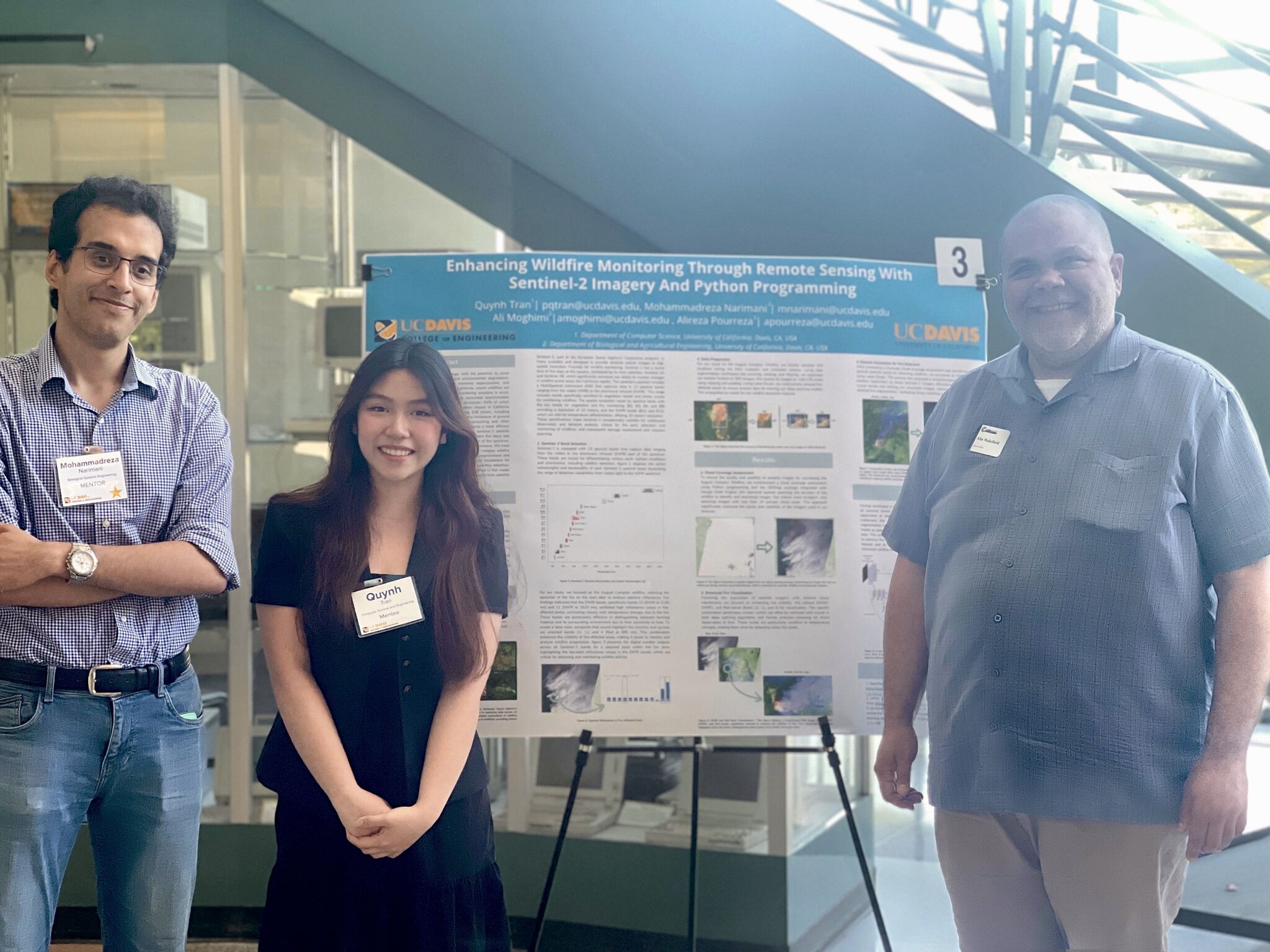
In Spring 2024, I had the privilege of mentoring my undergraduate mentee, through a complete research project—from ideation, dataset creation, coding, and visualization all the way to building a technical research poster and presenting it at the UC Davis College of Engineering.
This blog post highlights our work, the methods we used, and the outcomes of our wildfire monitoring research using Google Earth Engine (GEE) and Sentinel-2 imagery.
Project Overview

Project Title: Enhancing Wildfire Monitoring Through Remote Sensing With Sentinel-2 Imagery and Python Programming
Authors: Quynh Tran, Mohammadreza Narimani, Ali Moghimi, Alireza Pourreza
Affiliation: Digital Agriculture Laboratory, UC Davis
This project focuses on leveraging the SWIR (Short-Wave Infrared) bands of Sentinel-2 to identify wildfire-affected pixels, analyze fire progression, and build a dataset suitable for training deep learning segmentation models such as U-Net.
Mentoring the Project
As part of UC Davis' ESEARCH program, I guided my mentee through:
🧩 Step-by-Step Research Mentorship
- Designing the project objective
- Learning Google Earth Engine from scratch
- Understanding Sentinel-2 spectral properties
- Identifying optimal fire-sensitive bands (SWIR2, SWIR1, Red)
- Building Python preprocessing pipelines
- Visualizing fire progression
- Creating an annotated dataset for segmentation
- Designing and presenting a full scientific research poster
Seeing my mentee confidently present our work at the UC Davis College of Engineering was one of the most rewarding moments of my mentorship career.
Why Sentinel-2 for Wildfire Monitoring?
Sentinel-2 provides:
- 13 spectral bands including critical SWIR wavelengths
- Frequent revisit time (~5 days)
- High resolution (10m–20m)
- Free and publicly available imagery
SWIR bands (Bands 11 & 12) are particularly powerful for wildfire detection because:
- They are highly sensitive to heat
- They penetrate smoke better than visible light
- They clearly separate fire pixels from vegetation and soil
This makes Sentinel-2 one of the strongest tools for operational and research-level fire monitoring.
Methods & Pipeline
Our end-to-end workflow included:
1️⃣ ROI Selection & Cloud Filtering
We used Google Earth Engine to:
- Select regions affected by the August Complex Fire
- Sort images by cloud percentage
- Remove scenes with >10% cloud coverage
2️⃣ False-Color SWIR Visualization
We produced fire-enhanced images using:
SWIR2 (B12) + SWIR1 (B11) + Red (B4)
This made active fire zones immediately visible.
3️⃣ Data Preprocessing & Export
- Cropped all images to 128×128 pixels
- Standardized image formatting
- Exported images to Google Drive for offline work
4️⃣ Dataset Annotation
Using Label Studio, we manually annotated all 500 images to create a segmentation-ready dataset for fire-pixel identification.
5️⃣ Deep Learning Readiness
Our final dataset is structured for future use with:
- U-Net
- SegNet
- Attention U-Net
- Any custom wildfire-segmentation architecture
Results
The project successfully produced:
- A high-quality 500-image annotated dataset
- Accurate SWIR-based fire enhancement maps
- Reliable cloud-filtered GEE exports
- A complete research poster presented at UC Davis
This work lays the foundation for future graduate-level wildfire detection models using deep learning frameworks.
Future Work
As part of the Digital Agriculture Lab's ongoing research, our next steps include:
- Training a modified U-Net model on our dataset
- Performing hyperparameter optimization
- Extending the system to track multi-day fire progression
- Comparing Sentinel-2 results with Landsat-8, MODIS, and VIIRS
- Building an automated pipeline deployable for emergency agencies
This upcoming work will further strengthen our contributions to wildfire detection research.
GitHub Repository
Explore the full code, scripts, and workflow here:
This repository includes:
- GEE script for filtering and visualizing Sentinel-2 imagery
- ROI-based extraction tools
- Cloud filtering logic
- Python preprocessing and annotation pipeline
- Ready-to-train wildfire segmentation dataset structure
About the Author
Mohammadreza Narimani
PhD Candidate, University of California, Davis
Remote Sensing • Digital Agriculture • AI for Environmental Monitoring
I mentor students in satellite data analytics, drone sensing, Python, AI model development, and geospatial research through the Digital Agriculture Laboratory at UC Davis.
📧 mnarimani@ucdavis.edu
🎓 Google Scholar Profile
Conclusion
This project demonstrates how undergraduate mentorship, modern satellite imagery, and powerful cloud-based tools like Google Earth Engine can come together to produce meaningful real-world research.
I am incredibly proud of my mentee for her dedication and hard work, and I look forward to expanding this wildfire monitoring research as part of my PhD at UC Davis.